Writing your own sweeps¶
In the quickstart we used two small sweeps — average_children and propagate — to introduce the API. This notebook goes deeper:
Anatomy of a sweep declaration —
reads / reads_children / reads_parent / writesand what happens when you get them wrong.Equal-degree vs unequal-degree trees — the same user code routes through one segment-based backend, so reduction-style code behaves the same on both.
The children-axis reduction surface —
.sum / .prod / .max / .min / .mean(axis=0).Pattern: subtree size — count nodes per subtree with a single up-sweep that reads both
nodeandchildren.Pattern: depth from root — propagate root → leaf with a down-sweep.
By the end you will have written several sweeps from scratch and have a working mental model of the dispatcher.
import jax
import jax.numpy as jnp
import numpy as np
import matplotlib.pyplot as plt

import hyperiax as hx


def plot_tree(topo, values=None, ax=None, title=None, cmap='viridis',
              vmin=None, vmax=None, label_format=None):
    """Layered top-down layout. (Same helper as 01_quickstart.ipynb, with optional value labels.)"""
    if ax is None:
        _, ax = plt.subplots(figsize=(8, 5))
    pos = np.zeros((topo.size, 2))
    for d in range(topo.depth + 1):
        lo, hi = int(topo.level_starts[d]), int(topo.level_starts[d + 1])
        n = hi - lo
        pos[lo:hi, 0] = np.linspace(0, 1, n + 2)[1:-1] if n > 1 else 0.5
        pos[lo:hi, 1] = -d
    for i in range(1, topo.size):
        p = int(topo.parents[i])
        ax.plot([pos[p, 0], pos[i, 0]], [pos[p, 1], pos[i, 1]],
                'k-', lw=0.6, alpha=0.5, zorder=1)
    if values is None:
        ax.scatter(pos[:, 0], pos[:, 1], s=420, c='lightsteelblue',
                   edgecolor='k', zorder=3)
        for i in range(topo.size):
            ax.text(pos[i, 0], pos[i, 1], str(i), ha='center', va='center', fontsize=8)
    else:
        v = np.asarray(values)
        sc = ax.scatter(pos[:, 0], pos[:, 1], s=480, c=v,
                        edgecolor='k', cmap=cmap, vmin=vmin, vmax=vmax, zorder=3)
        plt.colorbar(sc, ax=ax, label='value', shrink=0.8)
        fmt = label_format or (lambda x: f'{x:.0f}' if abs(x - round(x)) < 1e-6 else f'{x:.2g}')
        for i in range(topo.size):
            ax.text(pos[i, 0], pos[i, 1], fmt(float(v[i])),
                    ha='center', va='center', fontsize=7, color='white')
    if title:
        ax.set_title(title, fontsize=11)
    ax.set_axis_off()
    return ax
1. Anatomy of a sweep declaration¶
Every sweep is a Python function wrapped by @hx.up or @hx.down. The decorator captures four pieces of metadata that act as a contract between you and the dispatcher:
kwarg |
Meaning |
Default if omitted |
|---|---|---|
|
Fields read from the current node. Available as |
All schema fields |
|
Fields read from each child. Available as |
All schema fields |
|
Fields read from the parent. Available as |
All schema fields |
|
Fields the function returns. The returned |
Required — no default |
The dispatcher uses these declarations to slice the right data, hand you a view, and scatter the right results back. Anything you didn’t declare is hidden from your function, and anything you return that you didn’t declare is rejected. Being explicit pays off when sweeps get bigger or read from many fields.
topo = hx.symmetric_topology(depth=2, degree=3)   # 1+3+9 = 13 nodes

tree = hx.Tree.empty(topo, {'value': (), 'weight': ()})
tree = tree.at[topo.is_leaf].set(value=jnp.ones(int(topo.is_leaf.sum())))
tree = tree.set(weight=jnp.linspace(1, 2, topo.size, dtype=jnp.float32))

@hx.up(
    reads=('value',),                   # from the current node we look at: value
    reads_children=('value', 'weight'), # from each child we look at:     value, weight
    writes=('value',),                  # we promise to write back:        value
)
def aggregate(node, children, params):
    # Inside an equal-degree up-sweep the user fn is vmapped, so per parent:
    #   node.value      : shape (n_parents_at_level,)
    #   children.value  : ChildrenAxis proxy over all children at this level
    #   children.weight : ChildrenAxis proxy over all children at this level
    # params is whatever you pass via sweep(tree, params=...), which is a global read-only constant during the sweep. Here we just use it to pass a bias term that gets added at every node.
    msgs = children.map(lambda c: {'weighted': c.value * c.weight})
    weighted = msgs.weighted.sum(0)
    return {'value': weighted + node.value + params['bias']}

new_tree = aggregate(tree, params={'bias': 0.1})
print('OK. Root value:', float(new_tree.value[0]))
OK. Root value: 18.075000762939453
Mistake #1 — reading a field you didn’t declare¶
The view only exposes what you declared in reads / reads_children / reads_parent. Anything else raises AttributeError, with a helpful list of what is available.
(If you leave a reads_* kwarg off, it defaults to “all schema fields” — convenient for one-shot prototypes, but stricter explicit lists pay off as your sweep grows: typos in field names get flagged immediately.)
@hx.up(reads_children=('value',),   # forgot 'weight' in reads_children!
       writes=('value',))
def forgot_to_declare(node, children, params):
    # c.weight isn't in scope because we didn't list it in reads_children.
    msgs = children.map(lambda c: {'weighted': c.value * c.weight})
    return {'value': msgs.weighted.sum(0)}

try:
    forgot_to_declare(tree)
except AttributeError as e:
    print('AttributeError:')
    print(' ', e)
AttributeError:
  Node field 'weight' is not available in this scope. Add it to `reads=...` on the sweep. Available: ['value']
Mistake #2 — returning the wrong keys¶
The returned dict must have exactly the same key set as writes. Extras or missing keys both raise SchemaMismatch.
@hx.up(reads_children=('value',), writes=('value',))
def wrong_writes(node, children, params):
    return {'value': children.value.sum(0),
            'extra': children.value.sum(0)}  # not in writes

try:
    wrong_writes(tree)
except hx.SchemaMismatch as e:
    print('SchemaMismatch:')
    print(' ', e)
SchemaMismatch:
  Up-sweep returned keys ['extra', 'value'] but writes=['value']. Extra: ['extra']; missing: [].
2. Equal-degree vs unequal-degree trees¶
Hyperiax uses one up-sweep backend for both shapes:
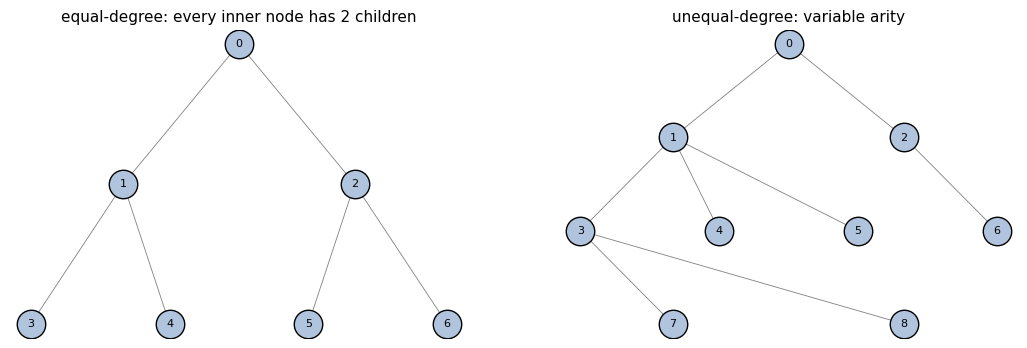
Equal-degree — every non-leaf has the same number of children.
Unequal-degree — children counts vary per node.
In both cases the dispatcher concatenates each level’s children into a flat array and assigns segment ids; reductions go through jax.ops.segment_*. Inside the body, node.X is batched (num_parents_at_level, *trailing), and children.X is a ChildrenAxis proxy that supports .sum / .prod / .max / .min / .mean(axis=0) plus children.map(fn), but not direct arithmetic or indexing.
The crucial property: identical user code works on both — as long as the only operations on the children axis are the supported reductions.
# Equal-degree: depth-2 binary tree, every inner node has 2 children.
topo_eq = hx.symmetric_topology(depth=2, degree=2)

# Unequal-degree: ragged tree (root has 2 children; node 1 has 3; node 2 has 1; node 3 has 2).
topo_uneq = hx.from_parents([0, 0, 0, 1, 1, 1, 2, 3, 3])

print('equal-degree topology:')
print(f'  equal_degree={topo_eq.equal_degree}  child_counts(non-leaf)={topo_eq.child_counts[~topo_eq.is_leaf].tolist()}')
print('unequal-degree topology:')
print(f'  equal_degree={topo_uneq.equal_degree}  child_counts(non-leaf)={topo_uneq.child_counts[~topo_uneq.is_leaf].tolist()}')

fig, axes = plt.subplots(1, 2, figsize=(13, 4))
plot_tree(topo_eq, ax=axes[0], title='equal-degree: every inner node has 2 children')
plot_tree(topo_uneq, ax=axes[1], title='unequal-degree: variable arity')
plt.show()
equal-degree topology:
  equal_degree=True  child_counts(non-leaf)=[2, 2, 2]
unequal-degree topology:
  equal_degree=False  child_counts(non-leaf)=[2, 3, 1, 2]
# Same up-sweep, run on both topologies.
@hx.up(reads_children=('value',), writes=('value',))
def sum_subtree(node, children, params):
    return {'value': children.value.sum(0)}

# Seed each tree's leaves with 1.0, so summing yields the leaf count.
tree_eq = hx.Tree.empty(topo_eq, {'value': ()})
tree_eq = tree_eq.at[topo_eq.is_leaf].set(value=jnp.ones(int(topo_eq.is_leaf.sum())))

tree_uneq = hx.Tree.empty(topo_uneq, {'value': ()})
tree_uneq = tree_uneq.at[topo_uneq.is_leaf].set(value=jnp.ones(int(topo_uneq.is_leaf.sum())))

out_eq   = sum_subtree(tree_eq)
out_uneq = sum_subtree(tree_uneq)

print(f'equal-degree   root = {float(out_eq.value[0])}    (expected leaf count = {int(topo_eq.is_leaf.sum())})')
print(f'unequal-degree root = {float(out_uneq.value[0])}    (expected leaf count = {int(topo_uneq.is_leaf.sum())})')

fig, axes = plt.subplots(1, 2, figsize=(15, 5))
plot_tree(topo_eq, out_eq.value, ax=axes[0],
          title='equal-degree: leaf count per subtree')
plot_tree(topo_uneq, out_uneq.value, ax=axes[1],
          title='unequal-degree: leaf count per subtree')
plt.show()
equal-degree   root = 4.0    (expected leaf count = 4)
unequal-degree root = 5.0    (expected leaf count = 5)
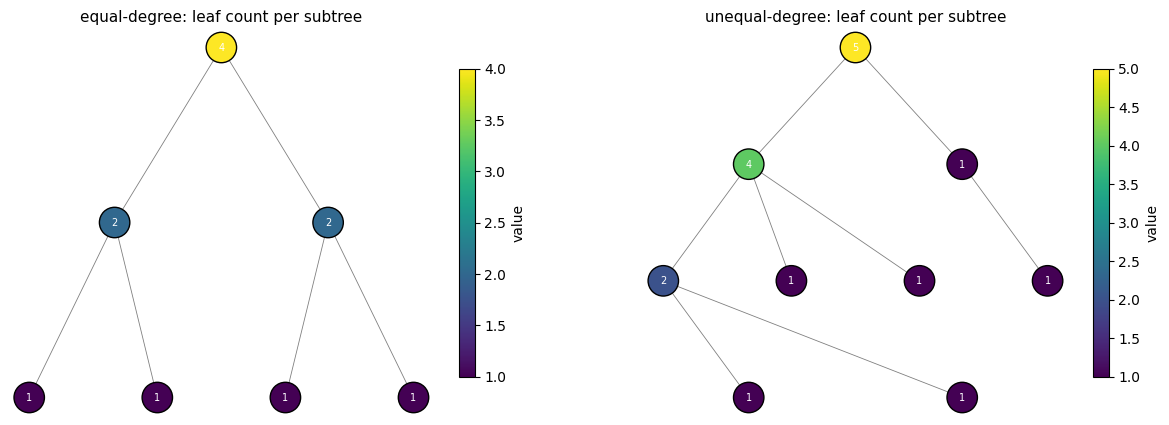
Note what just happened: we wrote one function, and it worked correctly on a 7-node binary tree and on a 9-node ragged tree with no changes. Both topologies used the same segment-based dispatch path.
The one thing to watch out for: children.X is a proxy, not an array. So direct elementwise children-axis arithmetic is rejected. Use children.map(fn) for per-child transforms, then reduce the returned fields with .sum / .prod / .max / .min / .mean.
3. The children-axis reduction surface¶
Five reductions, all reducing over the children axis (axis=0):
children.X.sum(0)children.X.prod(0)children.X.max(0)children.X.min(0)children.X.mean(0)
Each returns an array of the same trailing shape as X, one record per parent. We’ll run all five on the same input to see them in action.
We use a height-2 ternary tree (1 + 3 + 9 = 13 nodes) and seed the 9 leaves with [1, 2, …, 9]. At depth 1, each of the three inner nodes has children [1, 2, 3], [4, 5, 6], [7, 8, 9].
topo3 = hx.symmetric_topology(depth=2, degree=3)
tree3 = hx.Tree.empty(topo3, {'value': ()})
tree3 = tree3.at[topo3.is_leaf].set(value=jnp.arange(1, 10, dtype=jnp.float32))

def _make_reducer(reduce_fn):
    @hx.up(reads_children=('value',), writes=('value',))
    def sweep(node, children, params):
        return {'value': reduce_fn(children.value)}
    return sweep

sweeps = {
    'sum':  _make_reducer(lambda x: x.sum(0)),
    'prod': _make_reducer(lambda x: x.prod(0)),
    'max':  _make_reducer(lambda x: x.max(0)),
    'min':  _make_reducer(lambda x: x.min(0)),
    'mean': _make_reducer(lambda x: x.mean(0)),
}

print(f"{'reduction':<6} {'root':>10}   depth-1 inner values")
print('-' * 50)
for label, sw in sweeps.items():
    out = sw(tree3)
    print(f'{label:<6} {float(out.value[0]):>10.1f}   {np.asarray(out.value[1:4])}')

# Sanity-check one nice number: the full-tree product is 9! = 362880.
assert int(sweeps['prod'](tree3).value[0]) == 362880
reduction       root   depth-1 inner values
--------------------------------------------------
sum          45.0   [ 6. 15. 24.]
prod     362880.0   [  6. 120. 504.]
max           9.0   [3. 6. 9.]
min           1.0   [1. 4. 7.]
mean          5.0   [2. 5. 8.]
Worth noting: each call to _make_reducer creates a fresh SweepFn — a separately hashable, JIT-cached transform. The factory pattern is useful when you want the same body parametrized by a small callable (a reduction, a kernel, a similarity function). The dispatcher hashes on (direction, fn identity, reads/writes spec), so two sweeps built by the factory don’t share a cache entry.
4. Pattern — subtree size¶
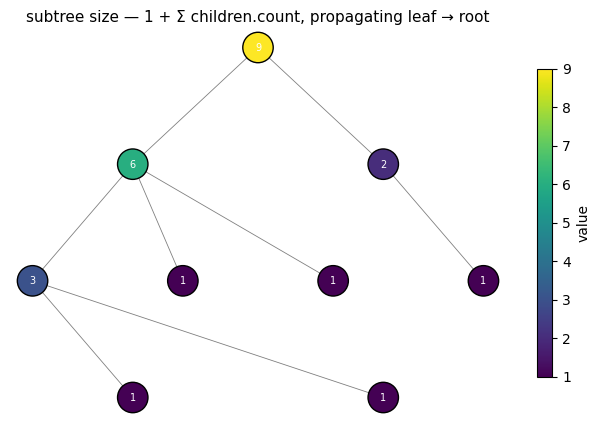
Problem: for every node, count how many nodes are in the subtree rooted there (including itself).
Recursion: size(leaf) = 1; size(inner) = 1 + Σ size(child). We seed every node with count = 1, then run an up-sweep that adds the children’s counts to the node’s own. Inner nodes get overwritten with the correct subtree size; leaves are never visited and keep their seed of 1.
This sweep is interesting because it reads both node.count (the seed) and children.count (already-computed subtree sizes one level deeper). It’s our first sweep using the reads= argument.
# Use the ragged tree from §2 — it makes the result more visually interesting.
tree_size = hx.Tree.empty(topo_uneq, {'count': ()})
tree_size = tree_size.set(count=jnp.ones(topo_uneq.size, dtype=jnp.float32))

@hx.up(reads=('count',), reads_children=('count',), writes=('count',))
def subtree_size(node, children, params):
    return {'count': node.count + children.count.sum(0)}

out_size = subtree_size(tree_size)

counts = np.asarray(out_size.count).astype(int)
print(f'subtree sizes per node: {counts.tolist()}')
print(f'root subtree size       = {counts[0]} (= total nodes = {topo_uneq.size}) ✓')

plot_tree(topo_uneq, out_size.count,
          title='subtree size — 1 + Σ children.count, propagating leaf → root')
plt.show()
subtree sizes per node: [9, 6, 2, 3, 1, 1, 1, 1, 1]
root subtree size       = 9 (= total nodes = 9) ✓
5. Pattern — depth from root¶
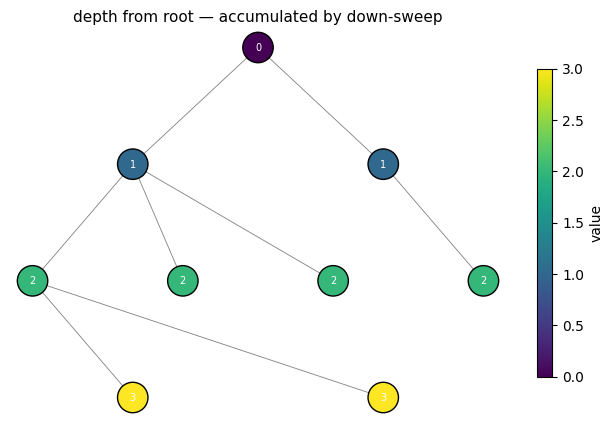
Problem: for every node, record its depth (root = 0, root’s children = 1, grandchildren = 2, …).
Recursion: depth(root) = 0; depth(node) = depth(parent) + 1. A down-sweep is the natural fit. The root is never visited by @hx.down (it has no parent), so we leave it at the schema’s default value of 0.
This sweep does not read node at all — we set reads=() to say so explicitly. Setting reads=() is a small ergonomic win: the dispatcher hands you an empty node view and any typo like node.X raises a clear error rather than silently being a no-op.
tree_d = hx.Tree.empty(topo_uneq, {'depth': ()})
# root.depth = 0 already (Tree.empty zeros everything), and the down-sweep never visits the root.

@hx.down(reads=(), reads_parent=('depth',), writes=('depth',))
def assign_depth(node, parent, params):
    return {'depth': parent.depth + 1.0}

out_depth = assign_depth(tree_d)

depths = np.asarray(out_depth.depth).astype(int)
print(f'depths per node:           {depths.tolist()}')
print(f'matches topo.node_depths?  {np.array_equal(depths, np.asarray(topo_uneq.node_depths))}')

plot_tree(topo_uneq, out_depth.depth,
          title='depth from root — accumulated by down-sweep')
plt.show()
depths per node:           [0, 1, 1, 2, 2, 2, 2, 3, 3]
matches topo.node_depths?  True
Recap & next steps¶
What you wrote in this notebook:
aggregate— a kitchen-sink up-sweep showing all four declaration kwargs plusparams.sum_subtree— one function body running unchanged on equal-degree and unequal-degree trees.Five reducer sweeps via a factory —
sum / prod / max / min / meanon the children axis.subtree_size— an up-sweep reading bothnodeandchildren.assign_depth— a down-sweep reading onlyparent(reads=()).
Things to keep in your head:
writes=is required and the returned dict’s key set must match it exactly. Everything else can default.Inside the function, shapes are per-parent on equal-degree trees and batched-per-level on unequal-degree trees, but reductions like
.sum(0)are written identically in both modes.Children-axis arithmetic (
children.x * children.y,children.x[0],jnp.where(children.x > 0, …)) works only on equal-degree trees. On unequal-degree trees the children axis is a virtual proxy; precompute elementwise expressions into their own field before the sweep if you need them.A
SweepFnis hashable. The dispatcher uses it as a JIT static argument and reuses compilations — callingsum_subtree(tree)a hundred times only compiles once.
Where to go next:
03_phylo_mean.ipynb— read a real Newick tree, run thephylo_meanprebuilt.04_phylo_bayesian.ipynb— Bayesian ancestral states (closed-form Gaussian posterior, exact smoothing via BFFG).05_gaussian_bffg.ipynb— drop “known hyperparameters” and run MCMC on the joint state-plus-hyperparameter posterior; uses these sweeps insidelax.scan.06_gaussian_nuts.ipynb—jax.gradthrough the same sweeps for gradient-based hyperparameter learning.